
Best e-Commerce Payment Platforms: Top 5 Options in 2026
What Are E-commerce Payment Platforms?
E-commerce payment platforms are digital systems that allow online businesses to accept and process electronic payments from customers. They act as intermediaries, securely transferring funds from buyers to sellers through various payment methods, such as credit cards, digital wallets, or bank transfers. Modern platforms offer features such as payment gateway integration, transaction processing, fraud prevention, compliance with standards like PCI DSS, and support for multiple currencies.
Popular e-commerce payment platforms include Luqra, PayPal, Stripe, and Square. These platforms handle the secure transfer of funds from a customer’s payment method, such as a credit card or digital wallet, to the merchant’s account, with options varying in features, pricing, and integration capabilities.
Key factors to consider when selecting payment platforms for e-commerce include:
- Transaction fees: Different platforms charge different rates for processing payments, which can significantly impact your bottom line.
- Payment methods: Ensure the platform supports the payment methods your customers prefer, such as credit/debit cards, digital wallets (Apple Pay, Google Pay), or “buy now, pay later” services.
- Security: Look for platforms with robust security measures to protect both your business and your customers’ data.
- Integration: Consider how well the platform integrates with your existing e-commerce platform or other business tools.
- Features: Some platforms offer additional features like fraud protection, advanced analytics, or a simplified checkout experience.
This is part of a series of articles about payment processing.
In this article:
Benefits of Using Modern Payment Platforms
Modern e-commerce payment platforms do more than just process transactions; they provide a set of tools and services that improve operational efficiency, security, and user experience. By integrating a modern platform, businesses can scale faster, reduce risks, and offer a smoother checkout process to customers.
Key benefits include:
- Faster setup and integration: Most platforms offer plug-and-play APIs and plugins for popular e-commerce systems, reducing the time needed to start accepting payments.
- Improved security: Built-in fraud detection, tokenization, and PCI DSS compliance help protect customer data and reduce liability.
- Global reach: Support for multiple currencies and localized payment methods allows businesses to sell internationally with minimal effort.
- Enhanced checkout experience: Features like one-click payments, digital wallets, and mobile optimization reduce cart abandonment and improve conversion rates.
- Unified dashboard and reporting: Centralized tools for monitoring transactions, managing disputes, and generating financial reports streamline operations and improve visibility.
- Scalability: As business grows, modern platforms can handle increased transaction volumes and expand support for new markets or payment methods without significant rework.
Types of Payment Methods Supported by E-commerce Payment Platforms
Credit/Debit Card Payments
Payment platforms facilitate real-time authorization and settlement between customers, card issuers, and merchants. They enable businesses to accept payments from all major card networks, such as Visa, Mastercard, American Express, and local alternatives relevant to specific markets. Payment platforms handle the complexities of card processing, including compliance requirements and security practices like tokenization and Secure Sockets Layer (SSL) encryption.
Support for recurring billing, pre-authorizations, refunds, and chargeback management is typically included, accommodating the varied needs of different e-commerce models. The ease and familiarity of card payments make them a preferred option for many buyers and are thus essential for merchants targeting high conversion rates. Choosing a platform with robust card payment support ensures smooth customer experiences and global scalability.
Digital Wallets and Mobile Payments
Digital wallets and mobile payments, such as Apple Pay, Google Pay, and PayPal, have gained popularity due to their speed and security. E-commerce payment platforms integrate with these wallets to enable one-click checkout experiences, minimizing friction at the point of sale. By storing payment credentials and using biometric or device authentication, digital wallets significantly reduce fraud risk and offer a seamless user journey on both desktop and mobile devices.
Increasing smartphone adoption and changing consumer preferences are driving mobile payment growth worldwide. For merchants, supporting digital wallets expands reach to customers who prefer not to use cards directly. Many platforms also allow loyalty program integrations and dynamic promotional offers within wallet ecosystems, which help boost repeat business and build brand engagement.
Bank Transfers / Direct Debit / ACH / Open Banking Options
E-commerce payment platforms commonly support bank-based payment methods, including bank transfers, direct debits, and Automated Clearing House (ACH) payments, as well as modern open banking solutions. These options are favored for high-ticket transactions, recurring billing, and B2B commerce, offering lower transaction fees compared to card payments. Direct integration with banks through open banking APIs also enables instant settlements and improved transaction visibility.
Platforms manage mandates, KYC/AML requirements, and regulatory protocols, making bank-based payments compliant and reliable for cross-border and local commerce. Customers benefit from a choice of familiar, trusted payment methods, while merchants gain wider reach into markets where card penetration is lower.
Multi-Currency / Cross-Border Payments
With global e-commerce on the rise, multi-currency and cross-border payment support has become a critical feature of payment platforms. Top platforms enable merchants to price goods and process transactions in dozens of currencies, automatically handling currency conversion and localized payment methods. This flexibility makes it easier to enter new markets and sell to diverse customer bases without operational friction.
Beyond currency conversion, advanced platforms also address related challenges such as local tax calculation, compliance with foreign regulations, and risk management for international sales. They may offer cross-border settlement solutions to minimize losses from unfavorable exchange rates and provide chargeback management tailored to international transactions.
Buy Now Pay Later
Buy Now Pay Later (BNPL) is a financing option that allows customers to split their purchase into interest-free installments, typically paid over weeks or months. E-commerce payment platforms integrate with BNPL providers like Klarna, Afterpay, and Affirm to offer this flexibility at checkout. These services appeal to budget-conscious consumers, or those looking to purchase large items but unable to pay the entire amount immediately, and can significantly increase average order value and conversion rates.
BNPL providers pay merchants upfront and assume the risk of collecting payments from the customer, giving businesses immediate revenue without added complexity. For users, the process is seamless, with approval often granted in seconds and no impact on credit scores in most cases.
Notable E-Commerce Payment Platforms
1. Luqra
Luqra is a payment processor built for businesses that need reliability and consistency in complex or high-risk payment environments. It provides stable payment acceptance, transparent underwriting, and proactive risk management to help merchants avoid disruptions like sudden account freezes or rolling reserves. By combining processing infrastructure with deep expertise in fraud, chargebacks, and processor behavior, Luqra supports sustainable, long-term growth.
Key features include:
- Unlimited scale: Uncapped accounts that allow you to grow as quickly as you can
- 24/7 in-house customer support: Always-on support staffed by Luqra employees, not outsourced call centers, ensuring fast and knowledgeable assistance when issues arise.
- Dedicated account representatives: Each merchant is paired with reps who understand their specific business model, risk profile, and processing history.
- Faster deposits: Accelerated settlement timelines help improve cash flow and reduce dependency on delayed payouts.
- Limited account freezes: Proactive risk monitoring and transparent communication significantly reduce sudden holds, shutdowns, or reserve surprises.
- In-house underwriting: Experienced underwriters perform full, manual reviews upfront and on an ongoing basis, rather than relying on automated or surface-level checks.
- Free chargeback and dispute management: Built-in support for handling disputes and chargebacks, helping merchants respond effectively without added cost.
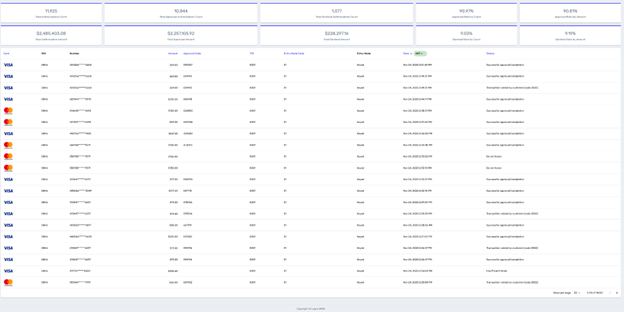
- VAMP Dashboard: First of its kind, real time VAMP data on TC15 and TC40 data allowing merchants to make adjustments to stay within allowances
Source: Luqra

2. PayPal
PayPal is a payments platform for online and in-person commerce. It provides checkout, risk and operations tools, and options to accept cards, PayPal, Venmo, and wallets across business sizes.
Key features include:
- Online checkout: Integrates PayPal’s checkout for e-commerce sites to accept payments from customers using stored PayPal accounts, cards, or wallets.
- Installment payments: Adds installment options at checkout so buyers can split purchases over time, with the financing experience presented as part of the standard payment flow.
- Guest checkout: Allows payment without logging into a PayPal account, enabling card payments as a guest to reduce friction during the purchase process.
- Accept Venmo: Enables accepting Venmo as a payment method alongside other options; availability only in the US.
- Invoicing: Supports sending invoices to customers and getting paid online, providing a workflow for merchants to bill and track one-off or repeat transactions.

3. Square
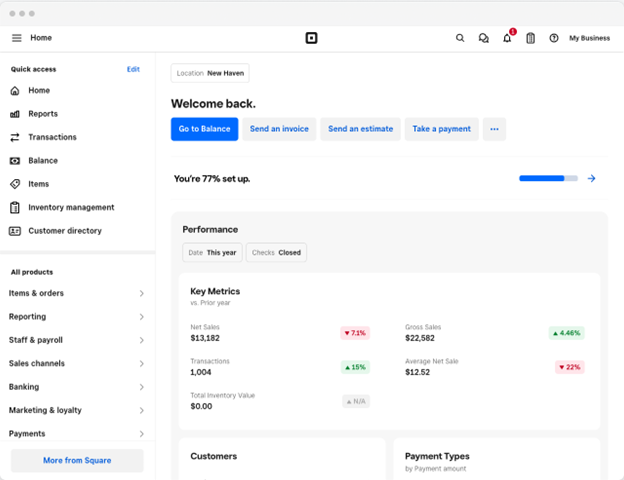
Square is a unified payment platform that supports online, in-person, and in-app transactions. It offers APIs and SDKs for integration, data security, and compliance tools. Square acts as the merchant of record, handling regulatory checks like PCI, KYC, and AML. Businesses can build custom payment solutions or use Square’s hardware and software.
Key features include:
- Online payments integration: Supports secure payment acceptance on websites via APIs and a customizable checkout form.
- In-person payments: Offers hardware and developer tools (Terminal API, Reader SDK) for building or using point-of-sale systems and kiosks.
- In-app payments: Enables embedding a payment gateway into mobile apps, with a customizable user experience.
- Software compatibility: Integrates with existing POS and online store platforms to reduce operational disruption.
- Compliance and security: Handles PCI compliance, KYC, and AML processes with encrypted transactions that bypass merchant servers.
- Fraud prevention: Leverages a $65B payments network and a dedicated risk team to reduce fraud without extra charges.
- Data and reporting APIs: Provides APIs for customers, catalog, and inventory to support enterprise-level reporting and integrations.
Source: Square Payments

4. Stripe
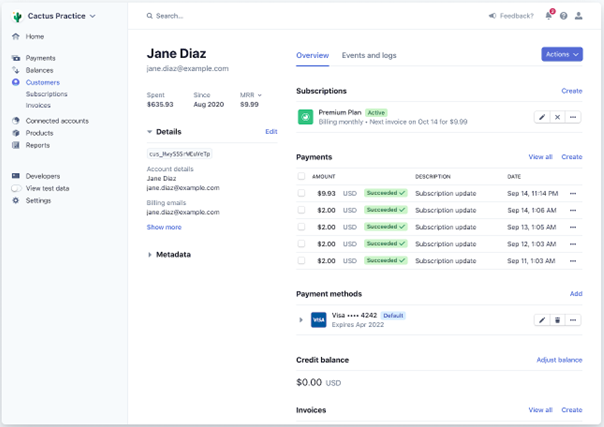
Stripe is a payments platform for online and in-person commerce. It supports many payment methods, one-click checkout, and devices for point-of-sale (POS), with tooling for platforms and payouts.
Key features include:
- Payment methods coverage: Offers access to over 100 payment methods, including buy now, pay later, bank debits, and real-time payments, with no-code rules and testing recommendations.
- One-click checkout: Provides a link for fast checkout, letting returning customers use saved bank accounts or cards to complete purchases in as little as seconds.
- In-person devices: Supplies pre-certified Terminal devices for use cases from countertop to curbside, supporting custom splash screens and POS applications on select readers.
- Payments for platforms: Includes Connect capabilities, supporting multi-party flows where platforms facilitate payments for their users.
- Payouts solution: Offers a dedicated payouts solution to move funds to sellers or recipients programmatically.
Source: Stripe

5. Adyen
Adyen is a payment platform used to accept, process, and settle payments online and in person. It offers web checkouts, links, plugins, and global processing with optimization and risk capabilities.
Key features include:
- Accept, process, settle: Consolidates online and point-of-sale payment processes in a unified setup.
- Web payments: Provides web payment experiences optimized for any device, with secure, native checkouts on any device.
- Global processing: Supports global payment processing through a single provider relationship.
- Pay by link: Enables sending secure payment links via any channel, with checkout hosted by Adyen to collect payments without custom development.
- E-commerce plugins: Offers plugins for leading e-commerce technologies to implement Adyen checkout and payment capabilities through integrations.

[Related content: Read our guide to online payment processors (coming soon)]
Key Factors to Consider for Choosing E-commerce Payment Platforms
Transaction Fees
Transaction fees are a primary concern for any e-commerce business evaluating payment platforms. These fees can include a combination of fixed costs per transaction, percentage-based charges, cross-border fees, and additional expenses for chargebacks or currency conversion. The structure and level of transaction fees can differ significantly between providers, affecting your overall profit margins and pricing strategy. Businesses should carefully estimate their expected transaction volume and average ticket size to select a payment platform offering competitive rates for their needs.
Beyond headline rates, it’s important to assess the entire fee landscape, including hidden or incidental charges that may apply based on transaction types or geographic location. Some platforms offer volume discounts or blended pricing models, which can benefit rapidly growing companies. Understanding the nuances of transaction fees ensures more accurate financial planning and helps prevent unexpected costs from eating into revenue over time.
Payment Methods
The range of supported payment methods directly impacts your conversion rates and potential audience reach. A payment platform should offer commonly used options for your target market—this may include local debit cards, international credit cards, digital wallets, bank transfers, and region-specific alternatives. Customers are more likely to complete purchases when offered familiar, convenient payment options, making broad payment acceptance a competitive advantage.
It’s also crucial to monitor evolving consumer preferences and emerging payment technologies. Platforms that regularly add new payment methods or adapt to shifting trends will keep your business relevant and accessible. Review the ease of enabling or disabling specific payment types, as well as any additional fees or technical requirements that may apply, to ensure your payment stack can scale with your business needs.
Security
Security is non-negotiable in e-commerce payment processing. Platforms must provide measures to protect sensitive information, such as end-to-end encryption, tokenization, and compliance with standards like PCI DSS. Secure payment processing not only defends against fraud and data breaches but also instills trust in your customers, encouraging repeat business and positive brand reputation.
Advanced features like real-time fraud monitoring, two-factor authentication, and dynamic risk scoring help mitigate evolving threats. Some platforms offer built-in chargeback management and dispute resolution systems, which can save resources and reduce business risk. When comparing platforms, scrutinize the level and transparency of security protocols, and prioritize those that make ongoing regulatory compliance straightforward.
Integration
Integration capabilities determine how smoothly a payment platform fits into your existing e-commerce technology stack. Modern platforms should offer ready-to-use plugins for popular e-commerce platforms such as Shopify, WooCommerce, Magento, and BigCommerce, as well as flexible APIs for custom implementations. Seamless integration minimizes technical debt, accelerates setup, and helps maintain a consistent, low-friction checkout experience.
Consider the quality of documentation, developer support, and ongoing maintenance offered by the payment platform. Platforms that facilitate easy updates, support various programming languages, and provide sandbox environments for testing are better suited for long-term success. Assessing integration features up front helps avoid compatibility issues and positions your business for smooth scaling and system upgrades.
Chargeback Management
Chargebacks occur when customers dispute a transaction, often due to fraud, product dissatisfaction, or delivery issues. Effective chargeback management is critical to minimizing revenue loss and maintaining healthy payment processor relationships. Leading e-commerce payment platforms offer automated tools for detecting and resolving chargebacks, helping merchants respond within required timeframes and reduce dispute ratios.
Key features may include chargeback alerts, real-time notifications, automated evidence submission, and detailed reporting dashboards. Platforms often integrate with third-party dispute management tools or provide in-house services to assist in building compelling cases. A robust chargeback system improves win rates, protects revenue, and ensures merchants stay within acceptable dispute thresholds to avoid penalties or account restrictions.
Visa Acquirer Monitoring Program (VAMP)
Visa’s Acquirer Monitoring Program (VAMP), launched in April 2025, replaces the Visa Dispute Monitoring Program (VDMP) and Visa Fraud Monitoring Program (VFMP) with a unified compliance framework.
VAMP introduces a new ratio formula that counts both TC40 fraud reports and total disputes, increasing the likelihood of enforcement actions, especially for merchants who rely on Rapid Dispute Resolution (RDR) or Verifi CDRN. The revised thresholds are stricter: merchants are flagged at 2.2% dispute or fraud ratios (dropping to 1.5% in 2026) with a minimum of 1,500 events. Acquirers face similar pressure, with “excessive” status beginning at 0.7%.
These changes require e-commerce businesses to reassess their fraud and chargeback management strategies. Since RDR and CDRN no longer exempt fraud-related disputes from monitoring, merchants must adopt alternative approaches like delayed capture, which allows transactions to be reviewed before funds are captured. Visa’s OneERS platform further supports acquirers by offering real-time visibility into dispute ratios and automating compliance tracking.
For payment platforms, supporting VAMP compliance means providing tools that help merchants reduce fraud, manage disputes efficiently, and monitor key performance indicators. As fines and stricter oversight take effect, platforms with robust chargeback prevention, fraud detection, and dispute resolution features will be critical for maintaining Visa compliance and avoiding costly penalties.
Reserve Policies
Reserve policies are mechanisms used by payment platforms to hold back a portion of merchant funds to cover potential future liabilities such as chargebacks, fraud, or refunds. These reserves are especially common for new accounts, high-risk industries, or merchants with volatile sales histories.
There are three common types of reserves: rolling (a percentage held for a set period), fixed (a flat amount held), and upfront reserves. Understanding a platform’s reserve policy is vital, as it affects cash flow and operational liquidity. Merchants should inquire about reserve triggers, review cycles, and release timelines. Platforms with transparent reserve practices and merchant-facing dashboards to track held funds improve financial planning and reduce disputes over withheld payments.
Volume Caps
Volume caps are limits imposed by payment platforms on the total transaction volume a merchant can process within a specific period, often daily or monthly. These caps help manage risk exposure for the platform, especially with new or high-risk merchants. If exceeded, transactions may be declined or settlements delayed.
Merchants should understand their initial processing limits and the criteria for increasing caps. Many platforms automatically review account performance over time to raise limits, especially when metrics like chargeback rate, fraud rate, and refund percentage remain low. Negotiable volume caps are particularly important for seasonal businesses or companies experiencing rapid growth, so look for platforms offering flexible scaling policies.
Tech Support
Reliable technical support is a crucial factor in payment platform selection, especially for businesses that operate around the clock or across global markets. Quality tech support reduces downtime, accelerates issue resolution, and ensures continued access to payment processing when problems arise.
Key considerations include availability (24/7 vs. business hours), response time SLAs, channels (email, phone, live chat), and whether support is in-house vs outsourced. Access to experienced technical account managers or developer support teams can significantly reduce friction during integration and maintenance phases. A platform’s ability to provide proactive guidance and fast troubleshooting is often a deciding factor in long-term satisfaction.
Conclusion
E-commerce businesses need a scalable payment processing solution that supports sustained growth without unnecessary holds, freezes, or volume caps. Luqra provides uncapped merchant accounts backed by extensive underwriting, helping online stores, subscription brands, digital product sellers, and high-volume ecommerce operations run with greater stability and confidence.
Direct integrations with Shopify, WooCommerce, Go High Level, Authorize.net, NMI, and SwipeSimple allow ecommerce merchants to launch quickly without downtime or complex migrations. Built-in fraud prevention tools, advanced chargeback management with Disputifier integration, and a proprietary VAMP monitoring dashboard help online sellers stay compliant with card network requirements while actively reducing disputes. A centralized ERP system streamlines ticketing, chargeback responses, deposits, and transaction tracking in one place, giving ecommerce operators full visibility into their payment environment.
Merchants benefit from uncapped merchant accounts designed to support high-volume ecommerce growth, allowing brands to scale ad spend, expand product lines, and enter new markets without artificial processing ceilings. Disputifier-backed automation reduces chargebacks, while real-time VAMP monitoring supports ongoing compliance as order volume increases. Seamless Shopify and WooCommerce integrations simplify implementation, and 24/7 in-house ecommerce risk support ensures store owners have access to experienced guidance whenever it is needed.
For e-commerce businesses seeking reliable payment processing built for long-term scalability, Luqra delivers a stable infrastructure designed to support consistent revenue growth.